Behind the studio.
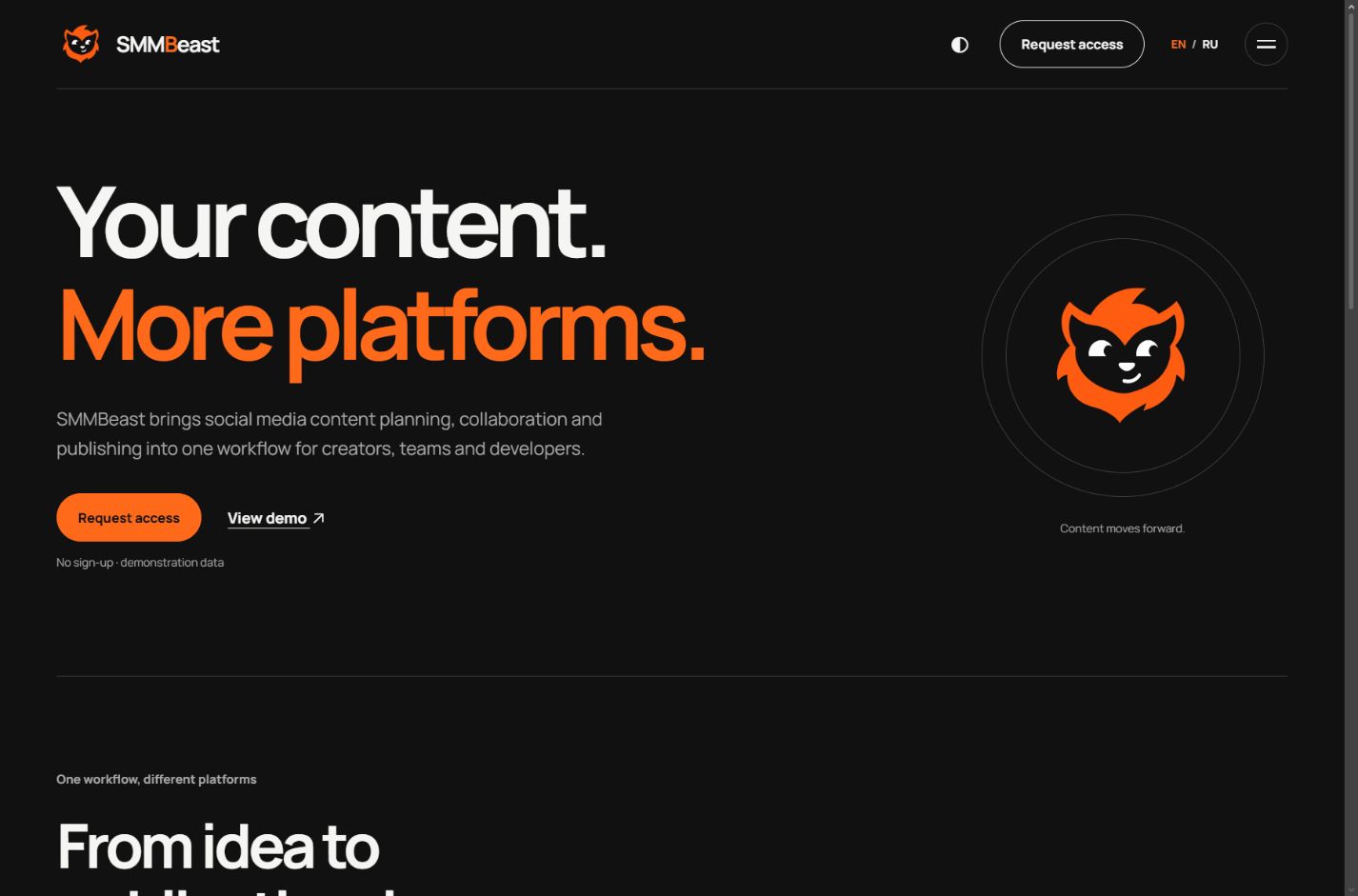
My latest project is SMMBeast, a workspace for planning social posts across brands and publishing to connected accounts. I’m building it alongside the tools I use to run my own online shop. Through Orloff Studio in Norway, I take on websites, integrations and automation for agencies and businesses.
Explore my work ↗ Independent practice
Orloff Studio
Building SMMBeast
If an agency manages several brands, a social post can start in a document, pick up a date in a calendar and end up in the wrong browser tab. I started SMMBeast to give each brand a place to plan its posts and give the person publishing a clear answer about what happened. It has a workspace for the people doing that work and an API for developers who need the same steps inside another product.
I decide how the product should work, guide development with AI tools and check the results in the interface and with the providers. The calendar records the editorial plan. Publishing to a connected account is a separate action. The app inspects supported images and video before sending and can resume an interrupted upload. If a platform stops responding after a send, the app can show that the outcome is uncertain so the operator can check before trying again.
Controlled tests covered Facebook Page publishing and a Reel from a professional Instagram test account, with insights returned by both platforms. SMMBeast is still in active development ahead of launch. The app is available by invitation and platform access depends on review and account permissions. The public demo uses fictional brands and posts.
The tools I built around my own work
Running a shop gives me a steady supply of problems to work on. With Lagrio, the challenge was keeping track of the materials that go into configurable products. A customer sees a lavender lead in their chosen width. The person managing stock needs to know exactly which material that choice used. An early version sometimes updated the wrong stock item, so I worked through the shop’s real order data and checked the corrections against its catalogue. Lagrio also helps with incoming stock from supplier PDFs.
Kontify started with the accounting work I did after a sale. It first connected WooCommerce orders to Tripletex invoicing. When I moved the shop to Medusa, the integration changed to Fiken, with checks on whether an order was complete, paid and fulfilled before accounting picked it up. I use both products as working betas, and onboarding is manual.
I also built a private CRM for the work itself. If a development task is waiting on research, I can ask for that research from Telegram and have the findings attached to the task. When I get back to my computer, I can continue from the files and the current decision without reconstructing the conversation. I choose when that handoff happens and what the research needs to answer.
Running ÅlesHund and delivering client work
I helped launch ÅlesHund, a Norwegian dog accessories business, and bought it in September 2025. I look after the website, sales, purchasing, customer questions, returns and accounting. Another person makes, packs and sends the products. I hear directly from customers when the store leaves something unclear. A buyer once expected a lead to come with a belt, so I moved the explanation up the product page where the next buyer could see it before ordering.
The November 2026 rebuild moved the store from WooCommerce to Next.js and Medusa, with Stripe and Vipps for payments and Kontify connecting eligible orders to Fiken. Product choices had to carry through to checkout and earlier orders had to stay available. I tested purchases myself with card and Vipps payments. I also work on search and Meta campaigns for the shop. My rules stop test campaigns that hit their time and spend limits without a lead. I can then look at what each lead costs in the campaigns still running.
My client work runs alongside the shop. For Rörlarmet24, I built a focused service site and now run Google Search ads in the Gothenburg area. On prakorin.com, I directed a WordPress restore from a saved copy and prepared a search plan the owner could act on. These assignments can start with a fresh brief or an existing site that the client needs to keep using.
Running iLikeIT Partners
Before working mainly on my own through Orloff Studio, I founded and ran iLikeIT Partners. I talked to clients, estimated the work, brought in specialists when we needed them and reviewed delivery. The share I did myself varied by project. I built the Peipsi Kalapunkt restaurant site personally. On the VIP Hospitality SEO project, I handled technical site changes as part of a wider team effort.
Case4You was a team project for a Shopify store selling custom phone cases. Choosing a phone model and preparing the design were the visible parts. A paid order also had to reach the correct printing partner, while an address that could not be validated needed a person to follow up. As the agency owner, I had to see that the brief covered that full journey and that people knew which piece they were responsible for.
Learning paid media with my own budget
I also spent roughly a year buying traffic on Facebook and Instagram for affiliate offers with my own money. I typically spent about €5,000 to €10,000 a month, with a peak of about €15,000. I adapted landing pages and creatives for different markets, tracked which combinations drove orders and decided where to keep spending. Campaigns covered physical products, including clothing and electronics. The tests that failed taught me when to stop spending and what to change in the next round.
I still use that approach in paid media. I look at the ad, the page someone lands on and the action the business is paying for. If a service business wants an enquiry, the work includes checking whether a visitor can understand the offer and contact the company from that page.
Sales and subcontracting before the studio
I sold doors in Tartu and arranged installation. The job meant hearing what the customer needed, agreeing what we would deliver and making sure the person doing the installation had the information to finish it. I later ran construction and cleaning businesses in Estonia and took on installation subcontracting in Finland, where I also brought in other tradespeople for jobs.
I still use habits from that work when I estimate a website or an integration. I ask who needs the result, what another person needs to know to take over and what we agree to do if the requirements change. Those questions are easier to answer while there is still time to adjust the scope.
Linux, hosting and my first websites
My first technical projects were in Estonia. A partner and I rented dedicated Linux servers for CServer.ee, set up Counter-Strike servers and installed mods for customers. A server could look fine while empty and slow down once players joined. Keeping the service running meant looking at the conditions under which people actually used it. We later offered web hosting and used cPanel for customer accounts.
I also built Joomla and other CMS sites for small businesses in Estonia and Finland. I showed owners how to make their own edits after delivery and provided support when they needed it. That was my first experience handing a system to someone who would use it without me sitting next to them.
How I fit into an agency project
I can take on a defined part of a larger brief, such as connecting a store to an accounting service, restoring a WordPress site, building a service site or investigating why a campaign’s landing page is losing enquiries. I use AI tools to research and build parts of the system. I stay responsible for the workflow, the checks and the handover. If a piece needs specialist review, I can make that part of the plan.
At the start, I ask to see the current system and agree with you on what needs to change and how we’ll check it. For an integration, that might mean following one test order from checkout through to accounting, then checking what happens if a payment or provider response is late. At handover, we review what was delivered, what was tested and any decisions the next person needs to know.