ÅlesHund
Building the storefront—and the operation behind it.

A shop I have to use every day
ÅlesHund is my own dog-accessories business. I helped with its original launch, acquired the business in September 2025 and created its digital store. I manage the website, advertising and SEO, but my work also includes purchasing, customer communication, returns and accounting. Another participant handles making, packing and sending the products.
Those responsibilities shape how I approach the website. A product page has to explain the right thing to a customer, while the resulting order has to carry enough information for production, payment, delivery and accounting. I encounter those connections in the business itself, rather than treating the storefront as a separate design exercise.
Starting with the economics and the questions
The earlier shop ran on WordPress and WooCommerce. After taking over, I reworked the homepage, product pages and descriptions. One practical problem was a low average basket value: advertising was difficult to justify when a customer bought only one item. I introduced an automatic discount for purchases of two or more products. I observed customers choosing more items, with a higher average order value and better advertising returns.
Customer conversations revealed another issue. One buyer believed that a lead was included with a belt. The explanation was already lower down in the description, but it was easy to miss. In the redesign, I moved that information into a more visible position. The page needed to explain what was included before the customer placed an order.
I also began developing a search channel alongside paid social advertising. The work covered search terms, headings, page copy and useful articles. A timely article about dog-leash rules became a concrete traffic source. GA4 helped me inspect how people moved through the site, while Search Console showed the queries and pages bringing visitors from Google.
I have now run Meta advertising for ÅlesHund continuously for a year. I also developed a campaign-rule system as part of that ongoing work, connecting advertising operations with the store I manage every day.
Across that year of Meta campaigns for ÅlesHund, my average ROAS has been approximately 2×–4×. This is the advertising result for the shop over that period, separate from the search-traffic comparison and the November storefront rebuild.
The rules automatically stop campaigns that have produced no leads once their configured time and spend conditions are met. This reduces the need to watch every test continuously and leaves me more time to analyse the campaigns and the product's advertising payback. The testing routine is described in the paid social and search case.
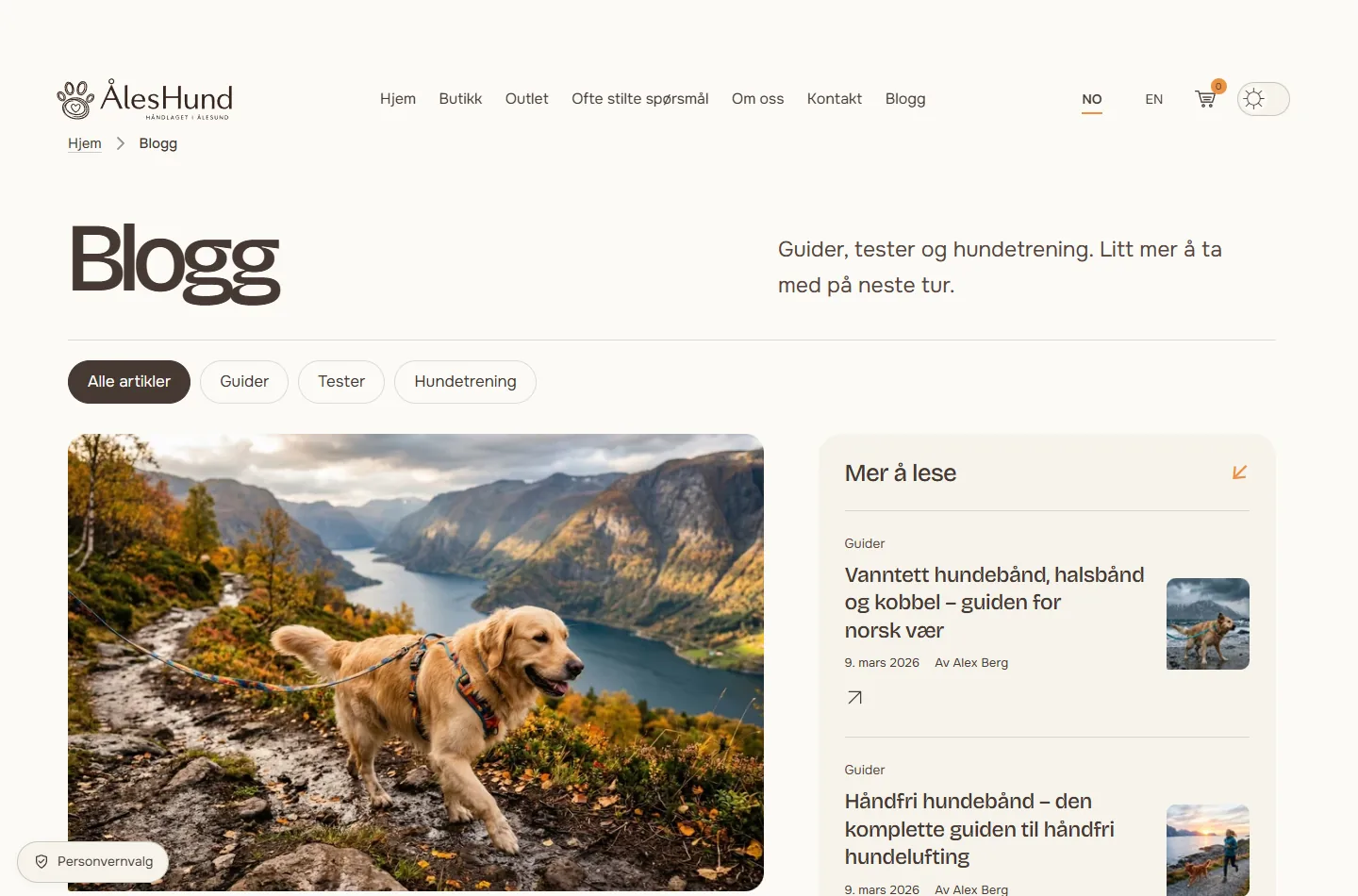
Replacing the shop without losing its working context
The current store is a live Next.js and Medusa implementation. It uses React and TypeScript, with PostgreSQL, Redis and Docker behind it. The move replaced the earlier WooCommerce setup with a product-configuration system tailored to the catalogue.
The product pages guide customers through conditional options and calculate the price on the server. The cart carries the selected parameters forward, supports quantity changes and coupons, and shows the delivery threshold. Customers can check out as guests. Norwegian and English storefronts cover the catalogue, articles and service information, with Stripe and Vipps for payments and Brevo for email workflows.
The migration also involved the less visible material around the products. The earlier store's exposed order history was preserved and reconciled against the final export, including its associated notes and refunds. Historical data stays distinct from new orders, so reporting can follow the business across the change without counting the archive twice.
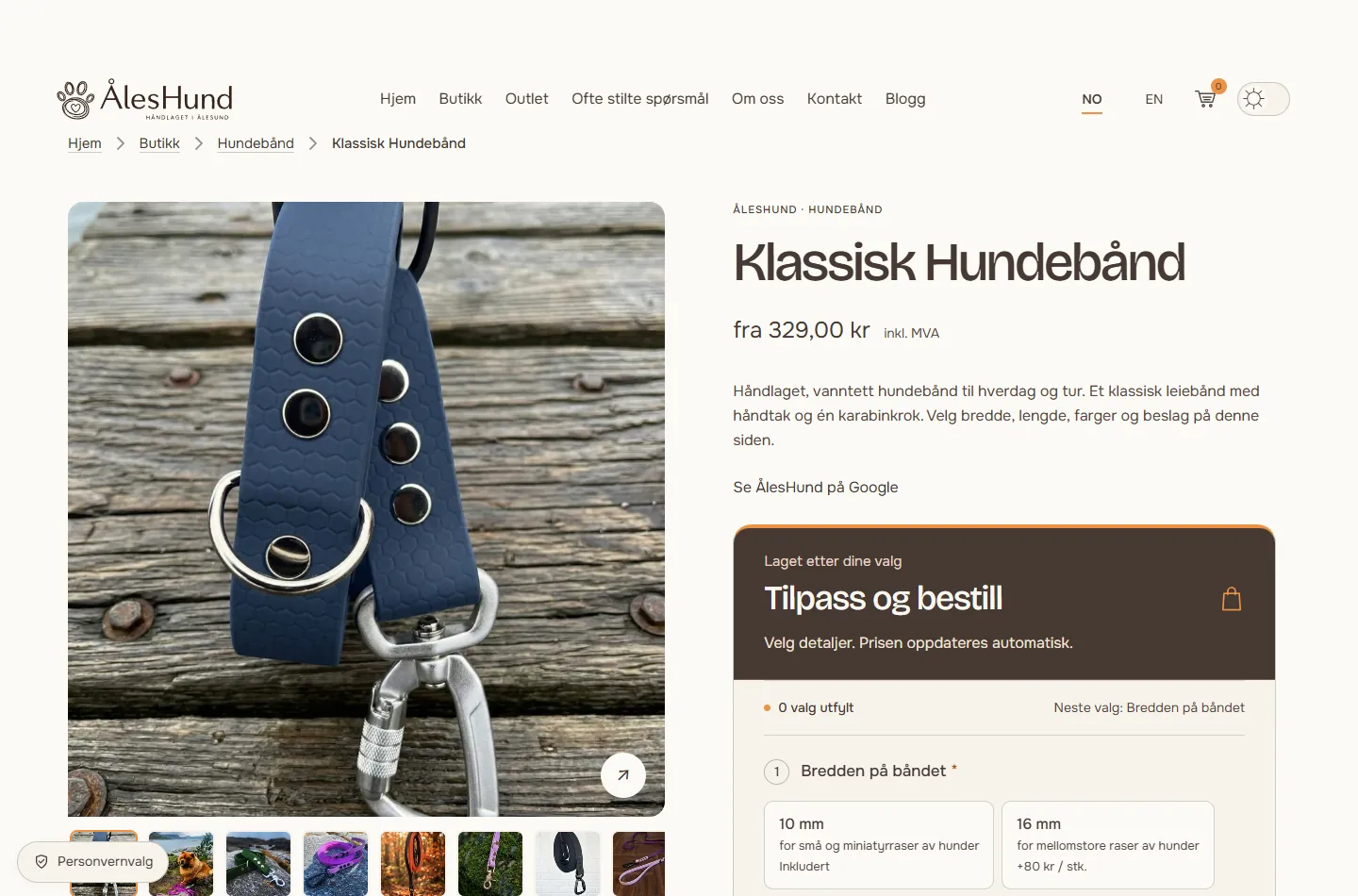
Connecting an order to the right next action
New eligible orders connect to Fiken through Kontify. The integration distinguishes order, payment and fulfilment states: marking a parcel as sent in the workshop is not the same as completing an order in the commerce system, and an authorised payment is not the same as a fully captured one. Those distinctions affect when accounting can safely take the next step.
The review workflow follows similarly specific rules. Product reviews are moderated. Invitations require consent and are scheduled seven days after the qualifying order's actual completion is observed. The system distinguishes products within an order and suppresses duplicate invitations. The workflow was enabled in November; its first observed scheduled pass had an empty queue, so customer delivery results will come from subsequent use.
How I checked the transition
My role covers the requirements, workflow design, AI-assisted implementation, review and production operation. I tested the customer journey myself with payment methods including card and Vipps and checked the emails. The launch work also included public-page checks, production canonical links, sitemap and robots behaviour, plus separate checks of the order-history preservation.
The review release received targeted backend and frontend tests, TypeScript checks and live checks of the Norwegian and English interfaces. This was a controlled addition to the live system: enabling the review workflow did not mean turning on every other feature present in the code. Cart-recovery and loyalty automation remained separate work.
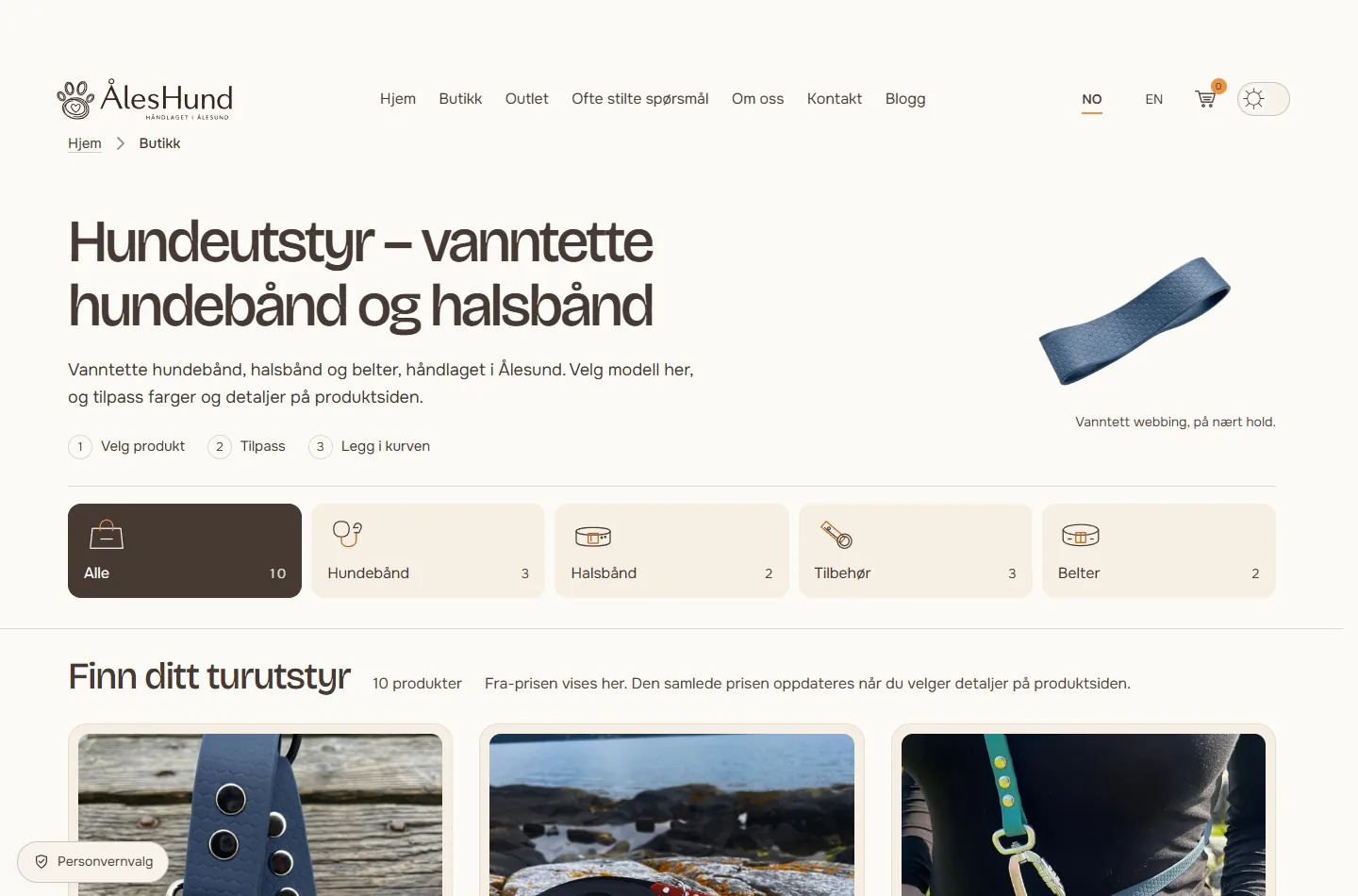
A result with a clear date attached
Before the November rebuild, the earlier store recorded 3,489 GA4 sessions from 3 August to 31 October 2026, compared with 2,470 from 5 May to 2 August. Google web search clicks increased from 1,221 to 1,391 over the same periods. The dog-leash-rules article received 239 Google web clicks in the later window. These figures describe the earlier shop and its ongoing marketing; the new storefront has its own operating history ahead of it.
I bring that experience to commerce assignments: connecting a configurable storefront to the business processes around it, carrying history through a migration, and checking the details that determine what happens after checkout.
A connected customer journey
An explanatory illustration of the live storefront and the operations around it.